Previous ELS Highlights

Mr Michael LELS (December, 2023)
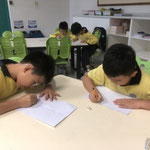
Writing stories/creative writing
An important part of learning a language is learning how to communicate in the written form. A good way for students to practice this is by having them create stories. We do this in a number of ways.
In class, we will watch a video to introduce the topic. We will then brainstorm vocabulary that can be used. The teacher will provide an example framework for how students should structure their writing. The students will then write their stories about the topic.
We can also use picture prompts. After we have brainstormed some vocabulary, the students will write about what they can see in the picture. They will also try to guess what the people might be feeling, what they will do later, etc.
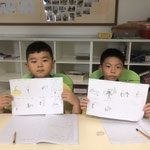
Another fun way to get the students engaged is to have them create comic strips about their daily lives, and things they like doing. This allows the students to be creative, and because it is about them, it means they are interested in trying to express themselves in English.
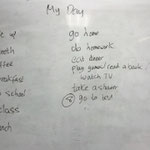
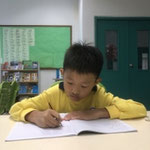
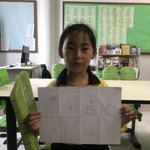
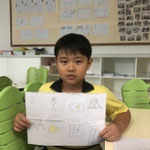
These activities are all designed to allow the students to be creative and have fun while using English. It starts off small, with only a few sentences. Eventually, we aim for students to be capable of producing a passage like in the final photo. With hard work and focus, we are confident they can do it. Well done ELS students!








Ms Belinda UELS (December, 2023)
The Thing about Phonics /th/ sounds
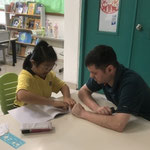
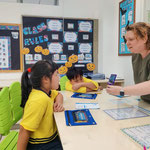
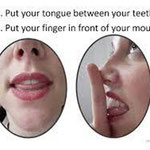
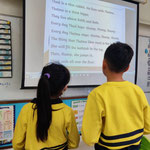
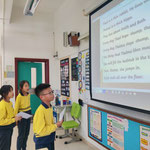
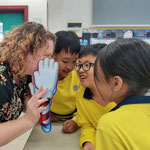
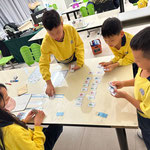
UELS.1 students have been working on digraphs during phonics lessons. We paid particular attention to the voiced and unvoiced /th/. In the first lesson, we introduced how to make the sounds. We focused on the position of the teeth, tongue, and lips and discussed soft and hard breathing using images and a mirror. Then, using a phonics video, we introduced and mimicked common words using the two sounds. In the following two lessons, we isolated voiced and unvoiced sounds. In both classes, we did a whiteboard activity where students wrote words using the letter sounds made by the teacher. This activity helps students decode new words when reading and improves their ability to sound out and spell words when writing (encoding). We then did short readings. We approach reading two ways. The first way is to analyze the story and identify the specific sound to improve decoding skills. The second is team reading races. The races help students trust their knowledge and attack a reading with confidence. (pic 9,10) We finished the unvoiced /th/ class with a whisper game to strengthen the use of phonics for writing. For the final activity in the voiced /th/ lesson, students played a Roll and Read game.
They challenged each other to decode unfamiliar words. In our last unit, we revisited both sounds using the whiteboard and reading activities. Then, they finished the /th/ unit with ‘Go Fish,’ where students successfully matched and sorted the two sounds.








Mr Tshepo LELS (January, 2024)
Inductive Learning:
Discovering the Importance of Transition Words
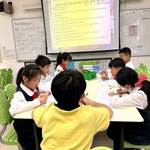
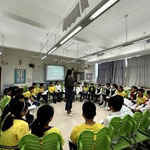
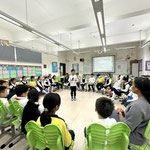
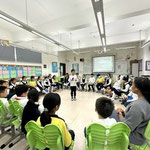
A typical English lesson consists of students walking into the classroom and waiting for the teacher to execute a lesson plan. But what if students were told that they would be their own teachers for the day? That is what happened to LELS 1 students this month.
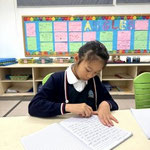
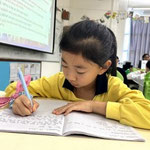
First, students were given scrambled flashcards, labeled A – I, which they had to organize. Some students organized the flashcards in alphabetical order whilst others organized them according to the pictures shown on the flashcards. Next, students read three short stories and were asked to find a grammatical structure that was consistent in the stories. This is where students discovered the use of transition words, i.e., words that show the relationship between sentences and paragraphs. They also discovered that the stories followed a sequence of events (6, 7). We brainstormed other words that can be used as transition words and watched a video to help come up with more words. Then, students realized that the flashcards they organized earlier told a story that followed a sequence of events. They reorganized their flashcards and presented the sequenced story using transition words. They also presented their own sequenced stories thereafter. Finally, once students understood the objective of our lessons, they were tasked with using the vocabulary and grammar they had discovered to write short stories of their own.
Students created stories that explained daily routines, weekend itineraries, instructions to activities, directions, etc. They did so through the process of self-discovery, that made students both the teacher and the student – an approach called Inductive Learning.










Ms Belinda UELS (June, 2023)
Language in Motion
This month UELS.1 students were working on prepositions of motion during grammar. Often the students do well in isolated grammar exercises but struggle to apply grammar when communicating. To help students make this connection, we highlight the grammar focus during other lessons. In the first grammar lesson, the teacher introduced the prepositions of motion. Students copied sentences using the words and completed written activities to ensure understanding. During the next lesson, we used movement. Students ran an obstacle course that emphasized the prepositions we were highlighting. For each task of the obstacle course, they said out loud what they were doing. Then they competed against each other using prepositions in their team-created obstacle course. The next day during writing lessons, we reviewed the activities from the previous class. Then students wrote a summary of their experience with the obstacle course. They were working not only on applying the prepositions but also report sequencing. Later that week, during listening class, students listened to a story about a hike in the forest and identified the preposition used to help readers understand the movement of the people and animals in the woods. Finally, we ended our focus in a writing class. We provided various photo prompts that showed animals in the forest doing activities. The students chose four of these photos to create a story map. They then wrote stories about their hike through the woods and what they saw. They successfully used the prepositions of motion in their tales.


Mr Tshepo ELS (June, 2023)
Identifying, reading and using Dolch words
This year, LELS 1 students reviewed Dolch words from the Pre-Primer list and learnt new words from the Dolch Primer list. Dolch words account for 50-75% of all vocabulary found in reading materials. Students who recognize and know the meaning of Dolch words are usually able to read books, and comprehend reading materials, easily.
During the month of May, we identified, read and used Dolch words through various media, games and activities. First, students were introduced to Dolch words through chants, songs and online videosThen students separated various vocabularies into Dolch words and non-Dolch words. Next, students read Dolch words from word searches, BINGO game cards and reading texts. Then, students had to count how frequently those Dolch words appeared in text, look up the definitions of the words using dictionaries and use those words to complete gap-fill activities to test students’ comprehension abilities.
Once students were able to successfully identify a list of Dolch words, and read and comprehend their meanings in reading materials, they finally had to use their understandings to create and write sentences of their own. Students were able to create unique sentences using any Dolch words of their choosing and drew wonderful illustrations to demonstrate the meaning of the sentences.
Identifying, reading and using Dolch words not only helped improve the students’ reading skills during Guided Reading but also their reading comprehension and writing skills – showing the importance of Dolch words in learning English!

Mr Ryan UELS (April, 2022)
Mindful Listening and Speaking
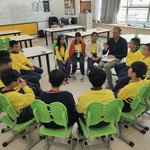
In this lesson the objective is for students to learn about their superpower sense of listening and speaking by listening and responding to questions with kindness, attention and mindfulness.
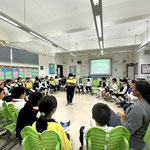
The lesson begins by having students sit in a circle, to become quiet and to close their eyes. In this activity they will be guided to listen to sounds around them with curiosity, which is like a superpower. The class will be guided to take two deep breaths and notice their belly rise and fall.
The teacher then rings a chime three times and asks the students to focus on the sounds. The students were then asked to listen to sounds behind and in front of them. All along they will be guided to be mindful of their breathing.
The students are then divided into pairs and partners will take turns talking for one minute, while the other partner will only listen. They will need to discuss “Their favorite place they have visited and why it is their favorite?” We then come together as a group and discuss what they noticed while completing this activity. E.g. how does mindful listening help us in discussions and interacting with others?
The students will then go back to their desks and complete the My Superhero Senses worksheet. They will need to write down all the things they listened to and then draw a picture of themselves listening to their partner.